


On The Palestinian National Charter (1968)
 May 17, 2025
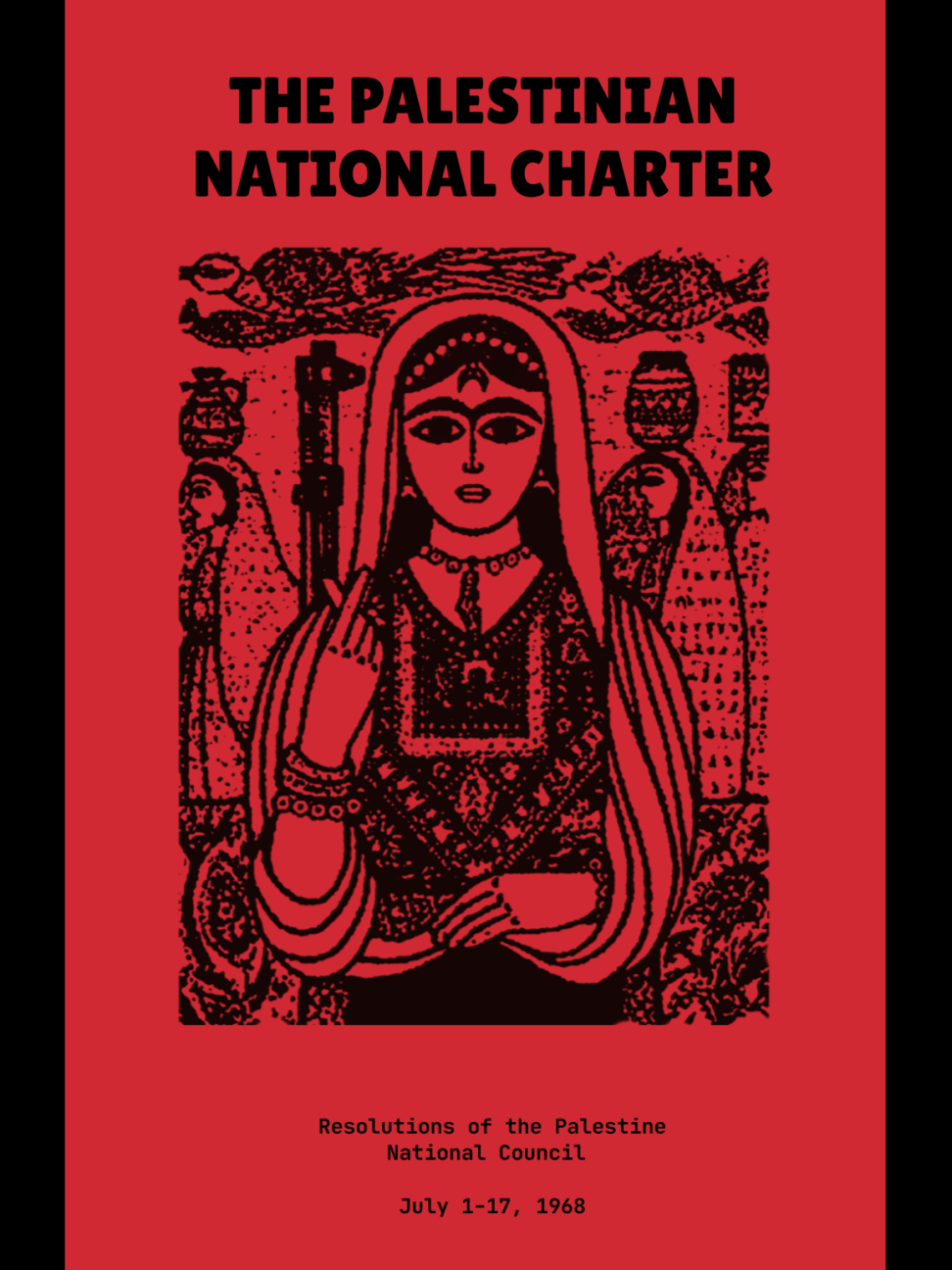
The following analysis was written by Tariq El-Tahrir Youth and Student Network and BDS Providence on the centrality and importance of the Palestinian National Charter, and the principles contained with-in it.
The Palestinian National Charter was composed by nearly 400 Palestinian men and women in late May 1964 (subsequently revised in June 1968). The principles laid out within it are universally accepted by all Palestinian factions, as well as all aspects of Palestinian society. A central document to the Palestinian national struggle, it was written at a time when the Palestinian cause was myopically viewed as an issue of forcibly displaced Arab refugees in need of resettlement opportunities. Against this backdrop, the Charter established, for the first time, independent Palestinian political and military decision-making. While recognizing the Palestinian Revolution as a part of the broader Arab Revolution, the National Charter insisted that the questions of the time, place, and manner for the confrontation with the Zionist entity were not primarily ones for the leaders of the Arab states, but for Palestinians themselves to answer. The composition, publication, and ratification of this document thus asserted the Palestinian Arab cause not only as a struggle for rights or resettlement, nor merely as an anti-apartheid campaign, but as a national liberation struggle for land and Palestinian self-determination organically connected to the liberation of the Arab nation and the worldwide anti-imperialist movement. By delineating the political orientation of the Palestinian national liberation struggle as we know it today, the Charter holds enduring relevance for organizational study.
In June 1974, the 12th Session of the Palestinian National Council adopted the Ten-Point Program of the PLO, whose political positions, by deviating from the National Charter, constituted the first major violation of the charter and the principles contained within it. At the 12th National Council, a so-called “interim project” was approved by the PLO leadership, which was comprised, largely, of the Palestinian national bourgeois class. The “interim project” was a signal from those who approved it to the leadership of the Zionist project that the PLO was willing to accept a compromise deal and signaled a shift within the ranks of the PLO leadership from an understanding of the Palestinian Revolution as struggling towards the liberation of Palestine to a movement for the formation of a Palestinian state on any Palestinian Arab land from which “Israel” were to withdraw. Not only did the Ten-Point Program imply that the liberation of Palestine could be partial, but it also misleadingly suggested this aim could be achieved by means other than armed struggle. This straying from the charter’s principles set the stage for future violations, including the largest and most catastrophic of betrayals, the Oslo-Madrid process.
The Oslo-Madrid process, from its inception, was a liquidation project, aiming to liquidate the Palestinian revolution, its demands, and its organizations on behalf of world imperialism. A small faction of the Palestinian leadership which can be accurately described as a comprador bourgeoisie collaborated with Zionism to implement the Oslo Accords, selling the right of return for millions of refugees and abandoning the principles outlined in the Charter. At the beginning of the negotiations between the PLO and the Zionist project, the PLO leadership put forward “letters of recognition,” in which the PLO (1) pledged the right of the Zionist entity to live in security and peace; (2) accepted UN Security Council resolutions 242 and 338 (both of which normalized the existence of the Zionist entity); (3) committed itself to pursuing a peaceful solution through negotiations between the parties (thus positing the possibility of peace under conditions of ongoing settler-colonial violence); (4) renounced its right to armed struggle (euphemistically referred to as “violence and terrorism”); (5) stated that it bore the responsibility of ensuring that the obligations contained in the agreement were not violated; and (6) that it would amend the National Charter in line with these obligations. The points contained within these letters of recognition, as well as the declarations and agreements which succeeded the Oslo-Madrid negotiations, including the Washington Agreement (commonly known as Oslo II) are clear violations of the principles of the National Charter. They resulted in the PLO leadership, acting in effective collaboration with Zionism, removing or amending almost the entirety of the Palestinian National Charter.
These deviations from the Charter manifest particularly clearly in the Palestinian Authority’s policy of “security coordination” with the Zionist regime. This is a euphemism for suppressing and policing the Palestinian resistance by incarcerating and even murdering resistance fighters. More generally, the Palestinian Authority attempts to normalize the Zionist entity within Palestinian society and to suppress resistance through a combination of legal mechanisms and force. Just as Palestinian resistance factions and civil society organizations have condemned the corrupt Palestinian Authority’s counterinsurgent role in the strongest terms, organizers in imperialist countries must become attuned to the forms of counterinsurgency internal to Palestine solidarity work. This not only means rhetorically supporting the resistance, but also developing a strategy – through trial and error – to escalate the struggle within imperialist countries to higher levels of militancy. Although peaceful protest and legislative work can play an important support role within such a strategy, excessive reliance on these tactics has failed to halt Zionism-imperialism’s genocide and cannot substitute for the more militant forms of action necessary to contribute meaningfully to the liberation of Palestine.
It is NOT the PLO, or any other Palestinian organization, which legitimizes the Charter; rather, it is adherence to the principles contained within the Charter – principles that arose through experiences of anti-colonial struggle – that grants any Palestinian entity or project legitimacy. Today, it is Resistance factions such as Hamas and Palestinian Islamic Jihad, the Popular Front for the Liberation of Palestine and others, regardless of their relationship to the formal PLO framework, whose commitment to militancy has remained steadfast, who concretize and form the living embodiment of these principles through their revolutionary actions. In order to stand in effective solidarity with the Palestinian Revolution, it is incumbent upon Palestine solidarity activists in imperialist countries to study and unite around the articles of the Charter. Solidarity cannot be conditional, and effective support for Palestinian national liberation requires activists and organizers to understand themselves and their organizations not as separate from the Palestinian Revolution, but as extensions of it within the imperial core. The full-scale genocidal war against Gaza since October 2023 has made it clearer than ever that there will be no peace in West Asia until the destruction of the Zionist entity, and that armed struggle is necessary for liberation. The Palestinian Revolution today thus requires the full dismantlement of the Madrid-Oslo process and its counterinsurgent legacy – starting with a reaffirmation of the Palestinian National Charter which grounds the struggle in the aims of the full liberation of Palestine, the death of Zionism, and the complete expulsion of imperialism from the Arab and Islamic Region.
The Palestinian National Charter: Resolutions of the Palestine National Council July 1-17, 1968
Text of the Charter:
Article 1:
Palestine is the homeland of the Arab Palestinian people; it is an indivisible part of the Arab homeland, and the Palestinian people are an integral part of the Arab nation.
Article 2:
Palestine, with the boundaries it had during the British Mandate, is an indivisible territorial unit.
Article 3:
The Palestinian Arab people possess the legal right to their homeland and have the right to determine their destiny after achieving the liberation of their country in accordance with their wishes and entirely of their own accord and will.
Article 4:
The Palestinian identity is a genuine, essential, and inherent characteristic; it is transmitted from parents to children. The Zionist occupation and the dispersal of the Palestinian Arab people, through the disasters which befell them, do not make them lose their Palestinian identity and their membership in the Palestinian community, nor do they negate them.
Article 5:
The Palestinians are those Arab nationals who, until 1947, normally resided in Palestine regardless of whether they were evicted from it or have stayed there. Anyone born, after that date, of a Palestinian father – whether inside Palestine or outside it – is also a Palestinian.
Article 6:
The Jews who had normally resided in Palestine until the beginning of the Zionist invasion will be considered Palestinians.
Article 7:
That there is a Palestinian community and that it has material, spiritual, and historical connection with Palestine are indisputable facts. It is a national duty to bring up individual Palestinians in an Arab revolutionary manner. All means of information and education must be adopted in order to acquaint the Palestinian with his country in the most profound manner, both spiritual and material, that is possible. He must be prepared for the armed struggle and ready to sacrifice his wealth and his life in order to win back his homeland and bring about its liberation.
Article 8:
The phase in their history, through which the Palestinian people are now living, is that of national (watani) struggle for the liberation of Palestine. Thus the conflicts among the Palestinian national forces are secondary, and should be ended for the sake of the basic conflict that exists between the forces of Zionism and of imperialism on the one hand, and the Palestinian Arab people on the other. On this basis the Palestinian masses, regardless of whether they are residing in the national homeland or in diaspora (mahajir) constitute – both their organizations and the individuals – one national front working for the retrieval of Palestine and its liberation through armed struggle.
Article 9:
Armed struggle is the only way to liberate Palestine. This it is the overall strategy, not merely a tactical phase. The Palestinian Arab people assert their absolute determination and firm resolution to continue their armed struggle and to work for an armed popular revolution for the liberation of their country and their return to it . They also assert their right to normal life in Palestine and to exercise their right to self-determination and sovereignty over it.
Article 10:
Commando action constitutes the nucleus of the Palestinian popular liberation war. This requires its escalation, comprehensiveness, and the mobilization of all the Palestinian popular and educational efforts and their organization and involvement in the armed Palestinian revolution. It also requires the achieving of unity for the national (watani) struggle among the different groupings of the Palestinian people, and between the Palestinian people and the Arab masses, so as to secure the continuation of the revolution, its escalation, and victory.
Article 11:
The Palestinians will have three mottoes: national (wataniyya) unity, national (qawmiyya) mobilization, and liberation.
Article 12:
The Palestinian people believe in Arab unity. In order to contribute their share toward the attainment of that objective, however, they must, at the present stage of their struggle, safeguard their Palestinian identity and develop their consciousness of that identity, and oppose any plan that may dissolve or impair it.
Article 13:
Arab unity and the liberation of Palestine are two complementary objectives, the attainment of either of which facilitates the attainment of the other. Thus, Arab unity leads to the liberation of Palestine, the liberation of Palestine leads to Arab unity; and work toward the realization of one objective proceeds side by side with work toward the realization of the other.
Article 14:
The destiny of the Arab nation, and indeed Arab existence itself, depend upon the destiny of the Palestine cause. From this interdependence springs the Arab nation’s pursuit of, and striving for, the liberation of Palestine. The people of Palestine play the role of the vanguard in the realization of this sacred (qawmi) goal.
Article 15:
The liberation of Palestine, from an Arab viewpoint, is a national (qawmi) duty and it attempts to repel the Zionist and imperialist aggression against the Arab homeland, and aims at the elimination of Zionism in Palestine. Absolute responsibility for this falls upon the Arab nation – peoples and governments – with the Arab people of Palestine in the vanguard. Accordingly, the Arab nation must mobilize all its military, human, moral, and spiritual capabilities to participate actively with the Palestinian people in the liberation of Palestine. It must, particularly in the phase of the armed Palestinian revolution, offer and furnish the Palestinian people with all possible help, and material and human support, and make available to them the means and opportunities that will enable them to continue to carry out their leading role in the armed revolution, until they liberate their homeland.
Article 16:
The liberation of Palestine, from a spiritual point of view, will provide the Holy Land with an atmosphere of safety and tranquility, which in turn will safeguard the country’s religious sanctuaries and guarantee freedom of worship and of visit to all, without discrimination of race, color, language, or religion. Accordingly, the people of Palestine look to all spiritual forces in the world for support.
Article 17:
The liberation of Palestine, from a human point of view, will restore to the Palestinian individual his dignity, pride, and freedom. Accordingly the Palestinian Arab people look forward to the support of all those who believe in the dignity of man and his freedom in the world.
Article 18:
The liberation of Palestine, from an international point of view, is a defensive action necessitated by the demands of self-defense. Accordingly the Palestinian people, desirous as they are of the friendship of all people, look to freedom-loving, and peace-loving states for support in order to restore their legitimate rights in Palestine, to re-establish peace and security in the country, and to enable its people to exercise national sovereignty and freedom.
Article 19:
The partition of Palestine in 1947 and the establishment of the state of Israel are entirely illegal, regardless of the passage of time, because they were contrary to the will of the Palestinian people and to their natural right in their homeland, and inconsistent with the principles embodied in the Charter of the United Nations; particularly the right to self-determination.
Article 20:
The Balfour Declaration, the Mandate for Palestine, and everything that has been based upon them, are deemed null and void. Claims of historical or religious ties of Jews with Palestine are incompatible with the facts of history and the true conception of what constitutes statehood. Judaism, being a religion, is not an independent nationality. Nor do Jews constitute a single nation with an identity of its own; they are citizens of the states to which they belong.
Article 21:
The Arab Palestinian people, expressing themselves by the armed Palestinian revolution, reject all solutions which are substitutes for the total liberation of Palestine and reject all proposals aiming at the liquidation of the Palestinian problem, or its internationalization.
Article 22:
Zionism is a political movement organically associated with international imperialism and antagonistic to all action for liberation and to progressive movements in the world. It is racist and fanatic in its nature, aggressive, expansionist, and colonial in its aims, and fascist in its methods. Israel is the instrument of the Zionist movement, and geographical base for world imperialism placed strategically in the midst of the Arab homeland to combat the hopes of the Arab nation for liberation, unity, and progress. Israel is a constant source of threat vis-a-vis peace in the Middle East and the whole world. Since the liberation of Palestine will destroy the Zionist and imperialist presence and will contribute to the establishment of peace in the Middle East, the Palestinian people look for the support of all the progressive and peaceful forces and urge them all, irrespective of their affiliations and beliefs, to offer the Palestinian people all aid and support in their just struggle for the liberation of their homeland.
Article 23:
The demand of security and peace, as well as the demand of right and justice, require all states to consider Zionism an illegitimate movement, to outlaw its existence, and to ban its operations, in order that friendly relations among peoples may be preserved, and the loyalty of citizens to their respective homelands safeguarded.
Article 24:
The Palestinian people believe in the principles of justice, freedom, sovereignty, self-determination, human dignity, and in the right of all peoples to exercise them.
Article 25:
For the realization of the goals of this Charter and its principles, the Palestine Liberation Organization will perform its role in the liberation of Palestine in accordance with the Constitution of this Organization.
Article 26:
The Palestine Liberation Organization, representative of the Palestinian revolutionary forces, is responsible for the Palestinian Arab people’s movement in its struggle – to retrieve its homeland, liberate and return to it and exercise the right to self-determination in it – in all military, political, and financial fields and also for whatever may be required by the Palestine case on the inter-Arab and international levels.
Article 27:
The Palestine Liberation Organization shall cooperate with all Arab states, each according to its potentialities; and will adopt a neutral policy among them in the light of the requirements of the war of liberation; and on this basis it shall not interfere in the internal affairs of any Arab state.
Article 28:
The Palestinian Arab people assert the genuineness and independence of their national (wataniyya) revolution and reject all forms of intervention, trusteeship, and subordination.
Article 29:
The Palestinian people possess the fundamental and genuine legal right to liberate and retrieve their homeland. The Palestinian people determine their attitude toward all states and forces on the basis of the stands they adopt vis-a-vis to the Palestinian revolution to fulfill the aims of the Palestinian people.
Article 30:
Fighters and carriers of arms in the war of liberation are the nucleus of the popular army which will be the protective force for the gains of the Palestinian Arab people.
Article 31:
The Organization shall have a flag, an oath of allegiance, and an anthem. All this shall be decided upon in accordance with a special regulation.
Article 32:
Regulations, which shall be known as the Constitution of the Palestinian Liberation Organization, shall be annexed to this Charter. It will lay down the manner in which the Organization, and its organs and institutions, shall be constituted; the respective competence of each; and the requirements of its obligation under the Charter.
Article 33:
This Charter shall not be amended save by [vote of] a majority of two-thirds of the total membership of the National Congress of the Palestine Liberation Organization [taken] at a special session convened for that purpose.